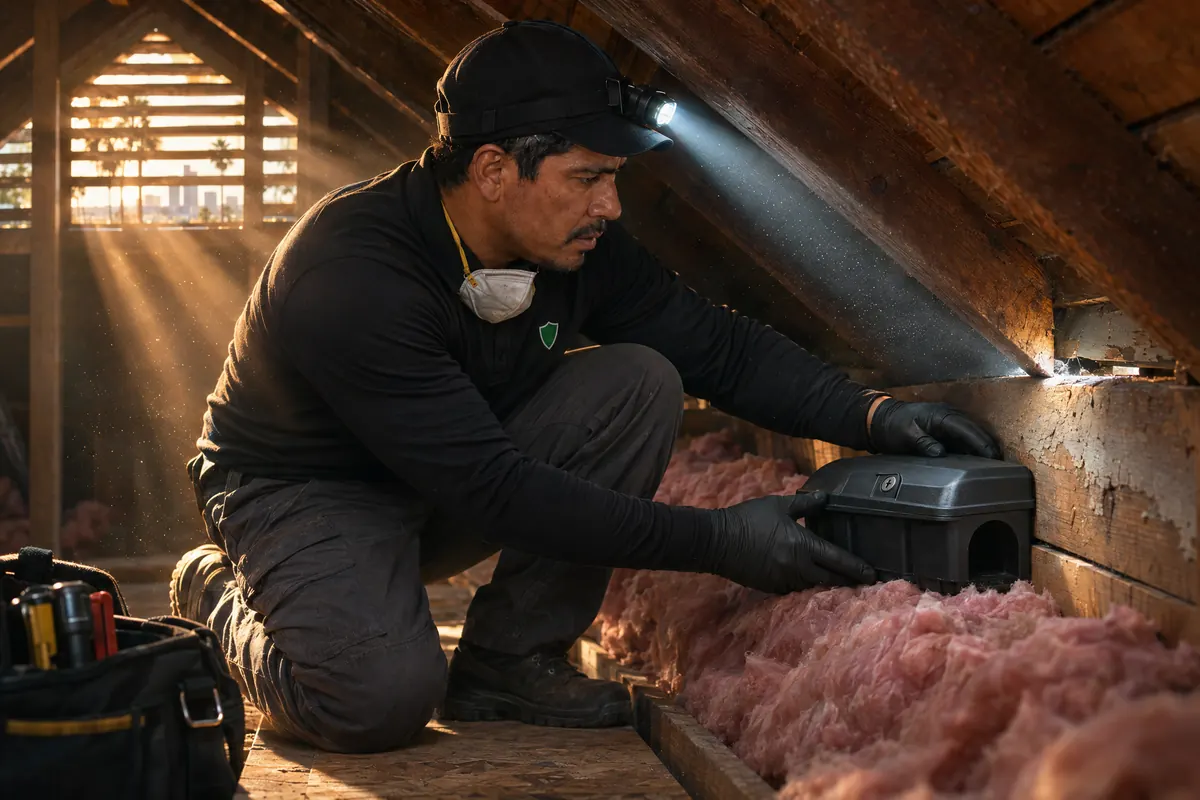
Rancho Cucamonga Pest Control, from Old Vineyard Land to the Foothill Edge
Rancho Cucamonga sits on old vineyard land below the San Gabriel Mountains, and most of its homes are newer than the vines the city still tends at Central Park. Census estimates put the median home at 1988. The north side, next to Alta Loma and Etiwanda, meets open wildland, while thousands of apartments sit in large complexes farther south. PesPro is a family-owned company that serves Rancho Cucamonga from its only office, in El Monte, for rodents, cockroaches, bed bugs, ants and other household insects.
4.9 stars from 138 Google reviews · 15+ years in business
Hours
Mon–Fri 8AM–6PM, Sat 9AM–3PM · 24/7 emergency line
Rancho Cucamonga at a glance
About 175,400 residents in roughly 60,900 homes; the median home was built in 1988 and only about 700 predate 1940 (US Census ACS 2020–2024).
Nearly 28,000 homes, about 46% of the total, date from the 1970s and 1980s, old enough for trees and hedges to have matured around them.
In ZIP code 91730, about 53% of households rent and roughly 4,950 homes are in complexes of 50 or more units; in 91739 the median home dates from 2002.
The city describes its northern boundary, beside the Alta Loma and Etiwanda neighborhoods, as a wildland-urban interface in a Very High Fire Hazard Severity Zone.
The California Department of Public Health lists the Aedes aegypti mosquito as present in Rancho Cucamonga (table updated May 1, 2026).
Mosquito and vector work belongs to the West Valley Mosquito and Vector Control District in Ontario; the county's own vector program does not list the city.
San Bernardino County inspects hotels and motels in Rancho Cucamonga but does not inspect its apartment buildings.
PesPro is family-owned and QualityPro accredited, works from a single office in El Monte, and its technicians speak English and Spanish.
Neighborhoods and landmarks we cover: Alta Loma, along the foothills, Etiwanda, the Cucamonga area around Foothill Boulevard and Vineyard Avenue, Foothill Boulevard (Historic Route 66), Central Park on Base Line Road, the Civic Center area on Civic Center Drive, the foothill edge near Almond Street, ZIP codes 91730 and 91739.
Old vineyard land, mostly newer homes
The city's own account of local wine history starts in 1839, when Mexico's acting governor granted about 13,000 acres to Tiburcio Tapia. Tapia planted a small vineyard, and the adobe winery built there is described by the city as California's first commercial winery. The site, at Foothill Boulevard and Vineyard Avenue on Historic Route 66, is California State Landmark No. 490.
Little of that era is left in the housing. Census estimates count about 60,900 homes with a median build year of 1988. Only about 700 predate 1940 and fewer than 2,700 predate 1960, while nearly 28,000 were built in the 1970s and 1980s and another 18,300 since 2000. The city and Galleano Winery now look after roughly 150 century-old grapevines that survive at Central Park.
For pests, that mix matters more than the history. Tract houses and apartments of those decades tend to have fewer of the crawl-space vents and old drains that let pests into pre-war homes. Problems here are more likely to start in the yard, the garage, the attic or a shared wall. [4][1]
Apartments in 91730, newer houses in 91739
Two of Rancho Cucamonga's ZIP codes show how different its housing can be. In 91730, Census estimates count about 13,600 renter households out of 25,800, or 53%. Close to 8,900 homes there are in buildings of five or more units, about 4,950 of them in complexes of 50 or more. In 91739, the median home was built in 2002, 72% of households own and about three in four homes are detached houses.
UC IPM calls the German cockroach the most common indoor species in California, above all in multi-unit housing. It also notes that bed bugs most often arrive on luggage, furniture and bedding, and that used mattresses are a high-risk source. In the large complexes those two pests are likely to move between units; around the newer detached houses, calls are more likely to be about ants, rodents in garages and attics, and outdoor cockroaches in meter boxes.
San Bernardino County inspects hotels and motels in Rancho Cucamonga, but its apartment inspections do not cover the city. A pest problem inside a rental therefore depends on the tenant reporting it and the owner acting on it. Our cockroach page for the city covers building-wide treatment in more detail. [2][3][14][16][12]
Where Alta Loma and Etiwanda meet the mountains
The city describes its northern boundary as running along the foothills of the San Gabriel Mountains, next to the Alta Loma and Etiwanda neighborhoods. It calls that edge a wildland-urban interface inside a Very High Fire Hazard Severity Zone, with rugged terrain and Santa Ana winds. It also lists three recent fires there: the Grand Prix Fire in 2003, the Etiwanda Fire in 2014 and the smaller Thorpe Fire in 2020, near Almond and Mai streets.
Homes beside open brush tend to get visitors that homes in the middle of town do not. UC IPM notes that California's native woodrats, or pack rats, may be found in and around homes; they eat fruit and nuts as roof rats do, but have furry tails. On a lot next to wildland, either one may be the rodent in the garage, and house mice are likely to follow stored birdseed and pet food.
The same clearing that protects a foothill house from fire also helps against rodents. UC IPM advises storing firewood and lumber off the ground, thinning dense plantings and keeping shrubs pruned away from the building so rats cannot travel unseen. [5][13]
Roof rats, mature trees and what the city asks of yards
UC IPM describes roof rats as agile climbers that nest above ground in trees, shrubs and dense vegetation such as ivy, and says residential areas with mature landscaping give them good habitat. They routinely travel 300 feet or more for food and are often seen at night on fence tops and overhead utility lines. With so many Rancho Cucamonga homes now 40 to 50 years old, the trees and hedges planted with them are likely to be full grown.
The UC guidance is to remove limbs within six feet of the roof, thin ivy and climbing vines, and pick up fallen fruit. One local rule applies before any tree comes down: the city requires a Planning permit to remove heritage trees, a category that includes its eucalyptus windrows and other large-trunked trees.
The city's Community Improvement staff also warn that discarded furniture, tires and debris stored outside can attract rats, and note that residents can book up to four free bulky-item pickups a year through the city's waste hauler. On the structure itself, UC IPM's standard is to seal every opening wider than a quarter inch and screen vents with half-inch galvanized mesh. That is the method we follow, alongside trapping. [13][1][6]
Coyotes are a call to the Animal Center, not to us
In July 2026, KTLA reported on a couple in a Rancho Cucamonga senior mobile home community who said a family of coyotes had been denning under their home for about three to four weeks. The city's animal services told the station that the property's managers had to report the den and allow access before staff could assess it, and that next steps could include the California Department of Fish and Wildlife.
The report also noted that a private citizen may not legally trap and relocate coyotes in California. The Rancho Cucamonga Animal Center says the same about its own staff: it offers advice on living with coyotes and responds to animals that are sick, injured or a public safety risk, but it is prohibited from trapping and relocating them. Its Field Services line is (909) 466-7387, extension 1.
PesPro treats rodents and insects only. Once a wild animal has left, we can inspect the space under a home or deck for the rats and mice that tend to use the same gaps, and close those gaps with metal. [8][7]
Mosquitoes, the West Valley district and summer ants
The California Department of Public Health lists the invasive mosquito Aedes aegypti as present in Rancho Cucamonga, and Aedes albopictus as not found. Mosquito work here belongs to the West Valley Mosquito and Vector Control District, formed in 1983 and based in Ontario. Rancho Cucamonga is one of its six member cities and appoints a trustee to its board. San Bernardino County's own vector program does not list the city.
The district inspects swimming pools and yards for mosquito breeding, supplies mosquitofish and offers a rodent inspection in which a technician checks a property's perimeter for rodents and entry points. It no longer removes bees. The city, for its part, requires pool and spa water to be kept clean and clear so it does not breed mosquitoes. The district's number is 909-635-0307.
Ants are the insect most likely to send a homeowner to the phone in hot weather. UC IPM says Argentine ants nest in shallow soil outdoors and come inside for food, water or relief from hot, dry conditions. It recommends baits over indoor sprays, along with caulking entry points and trimming plants so they do not touch the building. We follow that approach. [9][10][12][11][6][15]
Mature trees, hedges, fence tops and utility lines around 1970s and 1980s tracts
Woodrats & house mice
Fall and winter
Brushy lots, woodpiles and garages along the foothill edge of Alta Loma and Etiwanda
Argentine ants
Hot, dry spells and after rain
Trails into kitchens and bathrooms from shallow nests in yards and planters
German cockroaches
Year-round
Large apartment communities, hotels and restaurant kitchens; see the city's cockroach page
Bed bugs
Year-round
Apartments, hotels and secondhand furniture; neighboring units often need checking
Mosquitoes (awareness only)
Warm months
Aedes aegypti is present; report problems to the West Valley district
Pest reports in and around Rancho Cucamonga
Public-health notices, vector-control alerts and local news we track for this area. Summaries are ours; follow each link for the original report.
· KTLA 5
Elderly Southern California couple terrorized by pack of coyotes living under their home
Report on coyotes denning for several weeks under a mobile home in a Rancho Cucamonga senior community; city animal services said the property's managers must report the den and allow access, and the story notes private citizens may not trap and relocate coyotes in California.
Assemblymember Holden Presents the City of Rancho Cucamonga a $1.9 Million Check for an Early Wildfire Detection System
City news release describing the northern boundary beside Alta Loma and Etiwanda as a wildland-urban interface in a Very High Fire Hazard Severity Zone, and naming the 2003 Grand Prix, 2014 Etiwanda and 2020 Thorpe fires.
· The Sun / Inland Valley Daily Bulletin (Southern California News Group)
San Bernardino County restaurants shut down by health inspectors, Aug. 6-13
Weekly list sourced from county public health: a restaurant on 19th Street in Rancho Cucamonga was closed on Aug. 6, 2026 for a cockroach infestation; a Chino restaurant was closed for the same reason on that date.
· San Bernardino County Department of Public Health, Environmental Health Services · ehs.sbcounty.gov · regional
How to Manage Vermin in Hotels and Motels
County fact sheet for lodging operators: cockroaches hide in warm, moist areas, one seen in daylight may signal 50 to 100 more, and hotels should contract with a licensed pest control operator.
Pest control in Rancho Cucamonga: common questions
Does PesPro have an office in Rancho Cucamonga?
No. PesPro is a family-owned company with a single office, in El Monte, and our technicians travel from there to Rancho Cucamonga. We serve houses, apartment communities and businesses across the city. If your address is near the city line or in the foothills above it, call and we will confirm it is on our route.
My house was built in the 1990s or later. Can it still get rats?
Yes. UC IPM says roof rats nest in trees, shrubs and dense vegetation and reach roofs along fences, utility lines and overhanging limbs, whatever the age of the house. Garage door corners, roof vents and gaps around pipes are common ways in. Any opening wider than a quarter inch is worth sealing.
Who do I call about coyotes in Rancho Cucamonga?
The Rancho Cucamonga Animal Center, Field Services, at (909) 466-7387, extension 1. It gives advice on coexisting with coyotes and responds to ones that are sick, injured or a public safety risk, but it is prohibited from trapping and relocating them. PesPro does not handle wild animals; we work on rodents and insects.
Who handles mosquitoes or a green pool?
The West Valley Mosquito and Vector Control District, which counts Rancho Cucamonga among its member cities: 909-635-0307 or wvmvcd.org. It inspects pools and yards for mosquito breeding and supplies mosquitofish. The city also requires pool water to be kept clean and clear.
Rats are using a big tree next to my roof. Can I just remove it?
Check with the city first. Rancho Cucamonga requires a Planning permit to remove heritage trees, which include eucalyptus windrows and other large-trunked trees, and it can tell you what pruning is allowed. UC IPM's advice is to keep limbs at least six feet from the roof, which often solves the access problem without losing the tree.
Does anyone inspect Rancho Cucamonga apartments for pests?
Not the county. San Bernardino County inspects hotels and motels in Rancho Cucamonga, but its apartment inspection program does not cover the city. Tell your manager in writing as soon as you see roaches, bed bugs or droppings, and keep a copy. In a large complex the neighboring units usually need checking too.
Do your technicians speak Spanish?
Yes. Our technicians speak English and Spanish. Census estimates count about 29,650 Rancho Cucamonga residents who speak Spanish at home, roughly 7,650 of whom speak English less than very well, so we explain findings and preparation steps in whichever of the two languages you prefer.
San Bernardino County Department of Public Health, Environmental Health Services, “Housing and Lodging” (2026, ehs.sbcounty.gov).
San Bernardino County Department of Public Health, Environmental Health Services, “How to Manage Vermin in Hotels and Motels” (2014-12, ehs.sbcounty.gov).
San Bernardino County Department of Public Health, Environmental Health Services, “ABC Retail Food Inspection Guide” (2018, ehs.sbcounty.gov).
San Bernardino County Department of Public Health, Environmental Health Services, “Food Facility Risk Based Inspection Frequency” (2019-05, ehs.sbcounty.gov).